Core of the Design

What if every character—no matter how untrained—always had a chance to succeed?
In Sentius: Last Enclave, skill matters—but luck and grit can turn the tide. That’s why 12 is the magic number—the foundation of every roll, challenge, and triumph.
Twelve, the Magic Number
To illustrate the core principle, all skill checks have a die value and a bonus that, when combined, always total twelve.
| Training Level | Die Rolled | Bonus |
|---|---|---|
| Untrained | d12 | +0 |
| Apprentice | d10 | +2 |
| Professional | d8 | +4 |
| Expert | d6 | +6 |
| Master | d4 | +8 |
| Legendary | d2 | +10 |
The fixed success threshold of 12 keeps the system simple and predictable, ensuring every player at the table can easily recognize whether a roll succeeds or fails.
At first glance, it may seem like you must always roll the highest number on your skill die to succeed. However, the Grit Die represents a character’s resilience and determination—giving every roll a fighting chance.
- The Grit Die is usually a d6, but traits or conditions can modify it.
- Companions and creatures in the wilderness usually roll a d4, giving the player a slight edge.
Together, your Skill Die, Skill Bonus, and Grit Die determine your success.
| Roll Outcome | Effect |
|---|---|
| ≤ 8 | Critical Failure |
| 9 - 11 | Failure |
| 12 - 15 | Success |
| 16+ | Critical Success |
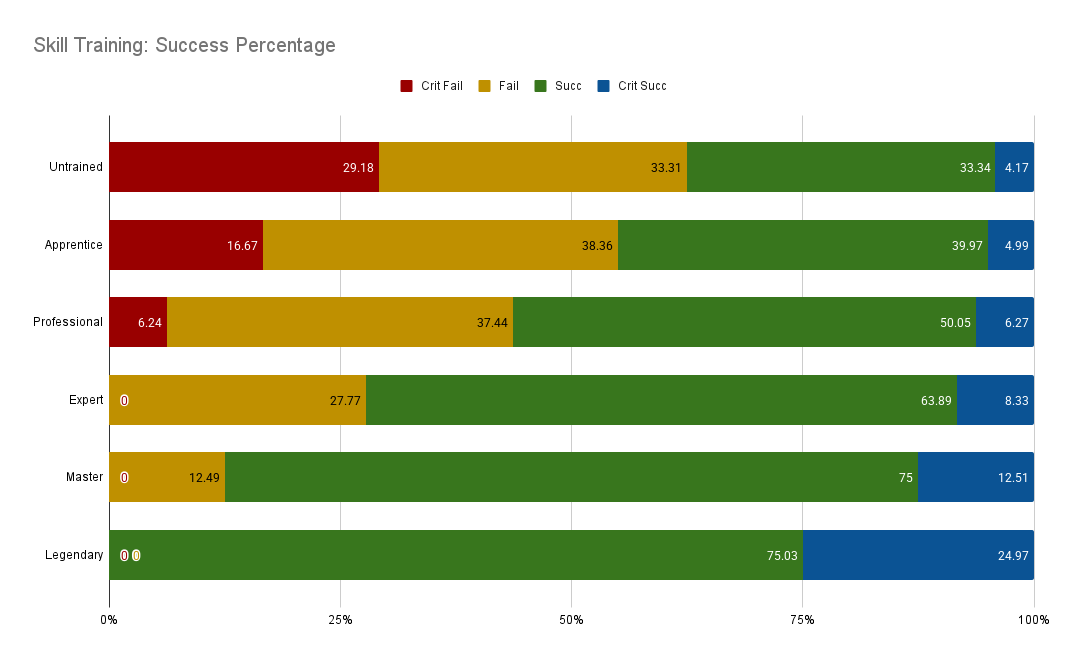
A Master without external penalties or bonuses can:
✔ Never critically fail
✔ Fail only 12% of the time
✔ Succeed 75% of the time
✔ Critically succeed 13% of the time
Difficulty Modifiers & Penalties
Some tasks are harder than others. The base target number is always 12, but difficulty penalties modify the roll:
| Difficulty | Penalty |
|---|---|
| Easy | +0 |
| Moderate | -1 |
| Stiff | -2 |
| Sheer Folly | -3 |
| Near Impossible | -4 |
| Impossible | -5 |
- More complex tasks impose penalties, requiring higher bonuses to succeed.
- Traits, gear, and advantages can offset penalties, keeping even "impossible" feats within reach for skilled characters.
Dice Checks
Two primary types of checks exist:
1️⃣ Direct Success Checks – Rolling against a set difficulty.
2️⃣ Contested Checks – Competing directly against another roll.
For example, in a Stealth contest, one character rolls Stealth, while the opponent rolls Perception.
- The higher total wins.
- If a roll beats the opponent's by 4 or more, it is a critical success.
- No critical failures occur in contested rolls.
Upgrades & Downgrades (Advantage & Disadvantage)
Certain situations upgrade or downgrade your training die based on luck, circumstances, or abilities:
- Upgrades: Increase the die size (e.g., d6 → d8).
- Downgrades: Decrease the die size (e.g., d8 → d6).
- The Grit Die remains unchanged.
- In addition to changing the die, upgrades provide a +2 bonus, while downgrades impose a -2 penalty.
| Upgrade Path | Downgrade Path |
|---|---|
| d2 → d4 → d6 → d8 → d10 → d12 | d12 → d10 → d8 → d6 → d4 → d2 |
Example Calculations
Upgraded Roll
A character with Expert (d6+6) training rolls:
✔ Upgrade: d8+8+d6
✔ Breakdown: d8 (upgraded die) + 6 (base bonus) + 2 (upgrade bonus) + d6 (Grit Die)
Downgraded Roll
A character with Expert (d6+6) training rolls:
✔ Downgrade: d4+4+d6
✔ Breakdown: d4 (downgraded die) + 6 (base bonus) - 2 (downgrade penalty) + d6 (Grit Die)
This system adds tactical depth, rewarding advantages while making disadvantages meaningful but not punishing.
Usage Checks (Resource Management)
Certain rolls don’t determine success or failure but instead track how long a resource lasts.
How Usage Dice Work
- Roll the current Usage Die.
- If the result is 1 or 2, downgrade the die (e.g., d8 → d6).
- If the result is 3 or higher, the resource remains intact.
| Usage Dice Flow |
|---|
| d12 → d10 → d8 → d6 → d4 → d2 → d1 → 0 |
This system tracks resources like:
✔ Health
✔ Ammo & Supplies
✔ Armor Durability
✔ Magic Reserves
Once a resource reaches d1 or 0, it is completely depleted.
Skills: The Foundation of Your Character
Every action your character takes—negotiation, combat, survival, hacking—relies on skills.
How Skills Work
- Characters start with 12 skill points at creation.
- Each skill is linked to two Primary Abilities.
- Training Level is capped by the highest die of those abilities.
- More investment = More reliability & specialization.
Choosing a Balanced Skill Set
A well-rounded character typically benefits from:
✔ A combat skill – Melee, firearms, or another form of self-defense.
✔ A utility skill – Hacking, scouting, or lockpicking.
✔ A social skill – Negotiation, deception, or intimidation.
✔ A survival skill – Navigation, scavenging, or medicine.
✔ A resistance skill – Defense against poisons, magic, or mental control.
Specialized Knowledge
Some skills—like Magic, Psychic Powers, and Totem Aspects—are only accessible through specific traits.
- If your character has access to one, they have unlocked unique powers.
- These must be learned separately and do not function like ordinary skills.
Your Skills Define Your Story
Because there are no classes, your skill choices define your character.
Are they a:
- Seasoned warrior?
- Resourceful scavenger?
- Cunning trickster?
- Master of the arcane?
Your skill choices will determine how you interact with the world.
✔ Convince a faction leader to aid you.
✔ Hack into an abandoned Enclave mainframe.
✔ Fight off raiders in the wasteland.
Every decision shapes your journey.
In Closing
This first look at my system shows how everything revolves around the number 12, ensuring that every character—no matter their skill—always has a chance to succeed.
This is just the beginning. Future posts will explore:
✅ How abilities shape characters.
✅ How skills evolve over time.
✅ How a dynamic world reacts to player choices.
Stay tuned! 🚀